
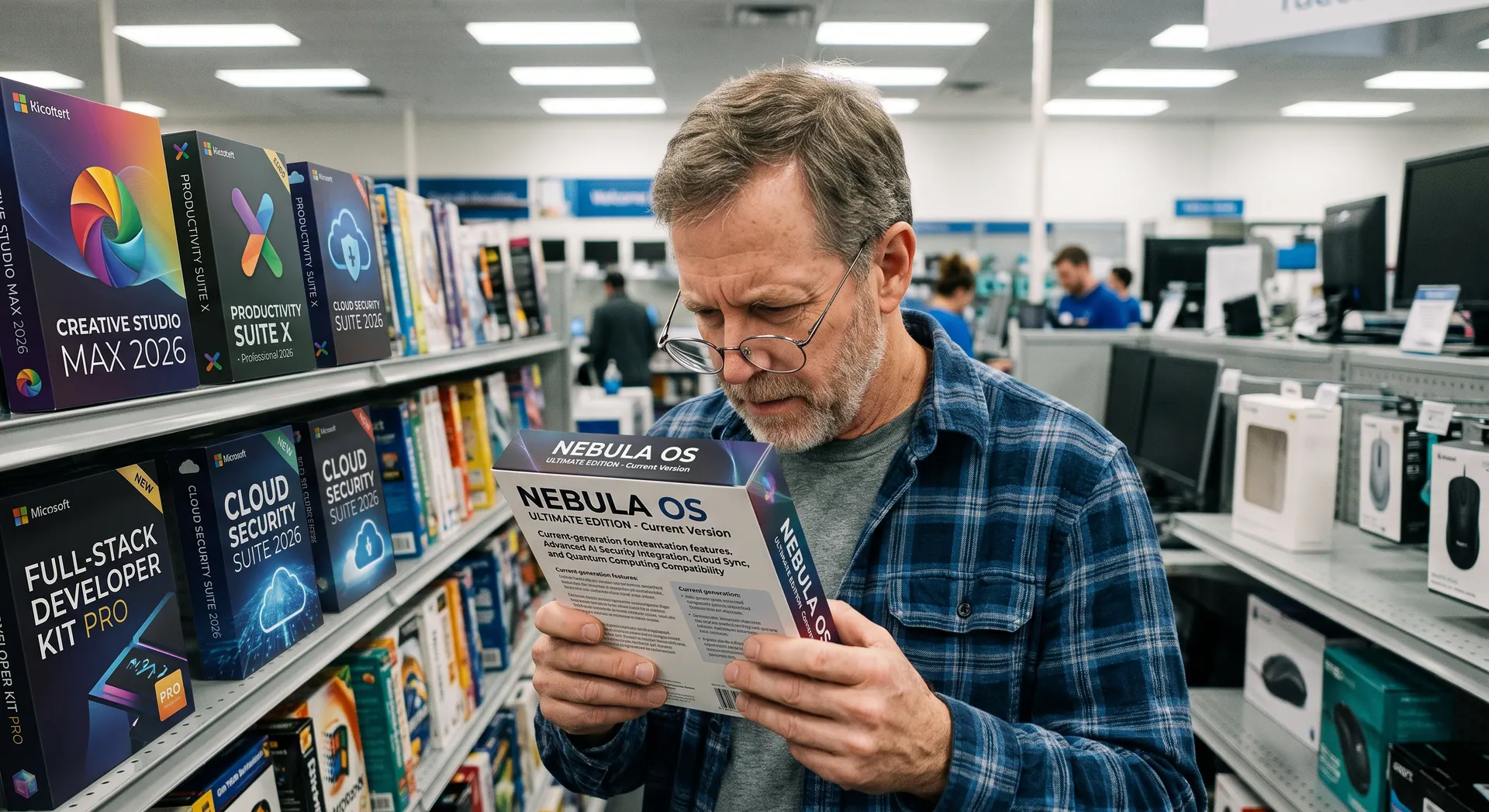
Software decisions have a habit of looking simpler from a distance.
A business finds a platform that appears to cover most of what it needs. The monthly price looks reasonable, the demo goes well, and implementation seems straightforward. Six months later, employees are maintaining side spreadsheets, customers are running into awkward limitations, and the business is paying for several add-ons just to keep the system usable.
The opposite happens too. A company decides its needs are unique, commissions a custom application, and discovers that it has spent time and money rebuilding features that an established product already handles perfectly well.
That is the real tension behind the build-versus-buy decision. Should you adapt your business to software that already exists, or build software around the way your business works?
There is no universal answer. The right choice depends on what the software is expected to do, how important that function is to the business, and what compromises the organization can realistically live with.
The choice is not as binary as it sounds
“Custom” and “off-the-shelf” are useful labels, but most real-world solutions fall somewhere between them.
Off-the-shelf software is built for a broad market. Accounting systems, customer relationship management platforms, payroll services, inventory tools, and project-management applications all fall into this category. They solve common problems using workflows intended to work for many organizations.
Custom software is designed for a particular business, group of users, or operating model. Its features, integrations, permissions, and user experience are shaped around a specific set of requirements.
Between those two ends are several other possibilities:
This middle ground matters because the best answer is frequently not “buy everything” or “build everything.” It is deciding which parts of the operation are ordinary enough to buy and which parts are valuable enough to build.
When buying is the sensible choice
Off-the-shelf software is usually the better option when the business need is common and well understood.
Most companies, for example, do not gain a competitive advantage from developing their own payroll system. Established payroll products already handle calculations, tax rules, reporting, and routine administrative work. Rebuilding those capabilities would introduce unnecessary cost and risk without creating much additional value.
Buying also makes sense when speed is the main concern. A packaged product can often be configured and deployed faster than a new application can be designed, built, tested, and introduced to users.
Other signs that favor an off-the-shelf solution include:
The key is to distinguish between a genuine mismatch and ordinary resistance to change. Every new system requires some adjustment. A company should not commission custom software simply because employees prefer the exact process they use today.
At the same time, forcing an unusual business into a generic workflow can create lasting friction. If employees have to build elaborate workarounds to make a product useful, the apparent convenience of buying may disappear quickly.
When building deserves serious consideration
Custom software becomes more compelling when the process being supported is central to how the company creates value.
Imagine a logistics business whose routing process helps it deliver faster or operate at a lower cost than its competitors. That routing capability is not just another administrative function. It is part of the company’s advantage. Depending entirely on a generic platform could limit what the business is able to do, or make its service look much like everyone else’s.
A custom solution may also be justified when:
Custom development should solve a meaningful business constraint. Wanting a different button layout or slightly more convenient reporting is rarely enough. Eliminating hours of repeated work, supporting a new service model, or creating an experience competitors cannot easily reproduce is a much stronger case.
Ownership also brings responsibility. Custom software must be maintained, secured, monitored, and improved. A company choosing to build is not making a one-time purchase. It is taking responsibility for a product.
The hybrid approach is often the practical answer
Many organizations benefit from treating standard software as infrastructure and reserving custom development for the areas where it creates an advantage.
A business might use an established accounting platform rather than building a general ledger. It might keep a commercial CRM as the central customer database. It could then develop a custom portal that gives customers a simpler experience, combines information from several sources, and supports workflows unique to the business.
In that model, APIs and middleware act as the connective tissue. Payroll and accounting can remain in proven commercial products. The company can configure its CRM, build the operational workflow that makes it different, and connect those systems so employees are not retyping the same information all day.
This approach avoids paying to reinvent routine capabilities while still giving the business control over the areas that matter most.
It is not automatically simple. Integrations can fail, vendors can change their APIs, and information can become inconsistent across systems. A hybrid environment still needs a clear architecture and a reliable owner. Done well, however, it offers a useful balance between speed and flexibility.
A six-part evaluation framework
Rather than beginning with a preferred product or development proposal, start with the business problem. Then evaluate each option through six practical lenses.
1. Functional fit
Begin by separating requirements into three groups: capabilities the business must have, capabilities that would be valuable but are negotiable, and preferences based mainly on current habits. That distinction prevents every request from becoming a mandatory custom feature.
It is also worth examining the process itself before automating it. Software can make a good process faster, but it can also preserve a bad process for years. If a workflow includes unnecessary approvals, duplicated information, or unclear responsibilities, correct those issues before using them as development requirements.
When reviewing commercial products, ask how much of the essential workflow is supported without modification. A product that covers most requirements cleanly may be a better investment than one with a longer feature list but a poor fit for daily work.
Frontline employees should participate in this evaluation. Executives understand the intended process, but the people doing the work know where the real exceptions, delays, and workarounds occur.
2. Total cost of ownership
The purchase price is only the beginning.
For off-the-shelf software, the full cost may include implementation, data migration, configuration, training, integrations, premium support, additional storage, optional modules, and higher subscription fees as the company grows.
Custom software has its own long-term costs. Discovery, design, development, testing, hosting, monitoring, security, support, and future enhancements all belong in the calculation.
Compare the options across several years. A packaged product with a low starting price may become expensive as users and transactions increase. A custom application may require a larger initial investment but offer more predictable costs later. Neither outcome should be assumed; it needs to be modeled using the organization’s likely growth.
The cost of doing nothing belongs in the comparison as well. Manual work, errors, delays, missed opportunities, and poor customer experiences all carry a price, even if they never appear as a software expense.
3. Time to value
A commercial product generally has an advantage when the organization needs a solution quickly. “Available now,” however, does not mean “useful tomorrow.” Configuration, migration, testing, and training still take time.
Custom development usually has a longer runway, but it does not need to arrive as one enormous finished system. A focused first release can solve the most valuable part of the problem, gather feedback, and begin producing results while later capabilities are still being developed.
The relevant question is not simply, “How long will this take to launch?” It is, “How long until this begins improving the business?”
4. Flexibility and scale
The solution should fit the company the day it launches, but it also needs room to grow.
Consider what happens when the organization adds employees, customers, locations, services, or transaction volume. Determine whether pricing remains manageable and whether the system can support more complex workflows.
For a commercial platform, the organization is partly dependent on the vendor’s direction. A desired capability may be added next quarter, years from now, or never. Heavy customization can create another problem: upgrades become difficult because the system has moved too far away from the product’s standard design.
Custom software provides greater control, but flexibility is not automatic. A poorly designed custom system can become just as rigid as a commercial product. Adaptability has to be planned into the architecture and supported through ongoing maintenance.
5. Integration and data control
Few business systems operate alone. A new solution may need to exchange information with accounting software, a CRM, an e-commerce platform, reporting tools, or equipment in the field.
Review the available APIs, documentation, authentication methods, and data-export options. Confirm whether integrations are included, require higher-priced plans, or depend on third-party services.
Data ownership deserves equal attention:
Being able to view data inside a platform is not the same as having practical control over it.
6. Risk and responsibility
Every option carries risk; it simply appears in different places.
With off-the-shelf software, the organization may face vendor lock-in, pricing changes, limited flexibility, service interruptions, or the possibility that an important feature will be changed or discontinued.
With custom software, the risks include unclear requirements, expanding scope, budget overruns, security gaps, technical debt, and dependence on a development partner or a small internal team.
The goal is not to find a risk-free option. It is to decide which risks the organization is best prepared to manage.
Ask who will own the system after launch. Who handles support? Who reviews security? Who prioritizes improvements? What happens if the original developers are no longer available? Those questions should be answered before development begins, not after the first serious problem.
Turning the framework into a decision
A weighted scorecard can help prevent the loudest opinion in the room from becoming the strategy.
List the factors that matter: functional fit, cost, launch time, scalability, integration, security, user experience, data control, vendor dependence, and strategic value. Assign each factor a weight based on its importance, then score the available options.
The score should support judgment, not replace it. Its real value is exposing disagreements and assumptions. If one team believes a feature is critical and another sees it as optional, that difference can be examined before money is committed.
Before making the final decision, ask:
A pilot, prototype, or limited implementation can answer some of these questions more reliably than another round of meetings.
Build what makes you different. Buy what does not.
Off-the-shelf software is usually the sensible choice when the problem is common, the available products fit well, and getting started quickly matters. Custom software becomes more attractive when the process is strategically important, existing platforms create expensive constraints, or greater control would produce a lasting advantage.
For many businesses, the strongest answer is a combination of the two: proven platforms underneath, custom capabilities where employees or customers benefit from something genuinely different.
The final decision should not be based on which option sounds more sophisticated or has the lowest initial price. It should be based on which one gives the business the best long-term result at a level of cost, risk, and responsibility it can actually support.