
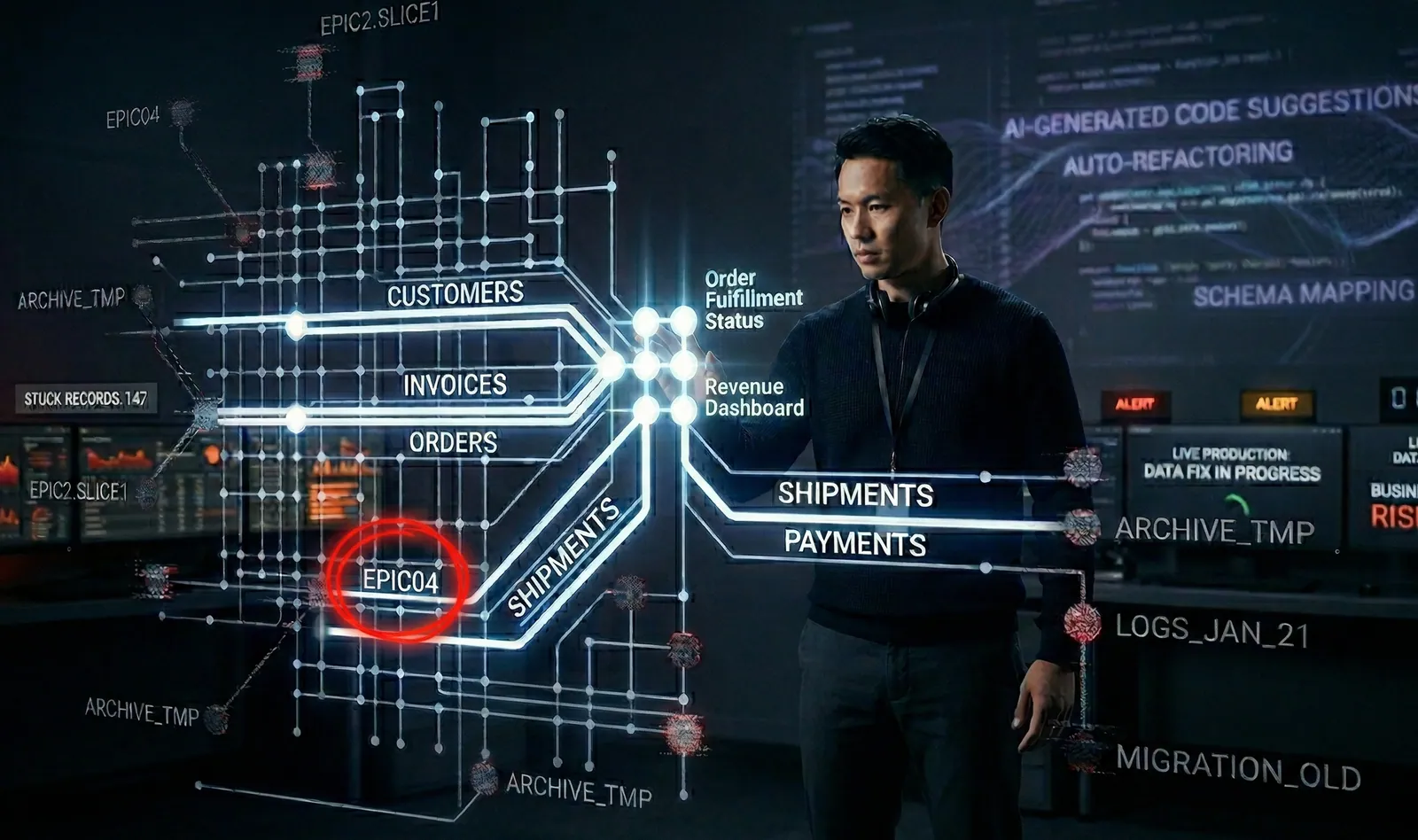
Naming is how the database explains itself
In an ideal world, the application code is the primary source of truth for intent: what a “customer” really is, which states an “order” can be in, how refunds are calculated, and what must happen when you mark something “deleted”. In the real world, production support rarely gets that luxury. Time is limited. Access is limited. The people who built the system are sometimes gone. In those moments, the database schema becomes the most reliable, most available artifact describing the system.
Most relational platforms expose schema metadata through the SQL-standard INFORMATION_SCHEMA views, which are intended to be relatively portable and stable across systems. When you do not have the source code, and you cannot spare hours to reverse engineer how the application behaves, your fastest path to understanding is often direct introspection: tables, columns, constraints, triggers, and relationships exposed through metadata.
This is where naming stops being a cosmetic choice and becomes operational infrastructure. The name of a table is the first line of documentation, the first search term in an emergency, and often the first clue you get about what you are allowed to touch and what you should avoid. Even the difference between metadata sources matters: for example, INFORMATION_SCHEMA is meant to be a standardized surface, while system catalogs are vendor-specific and can include implementation details.
When you support an app without the code, table names become your interface
I have supported applications where I had no access to the source code, or there simply was not time to read and understand it. I still needed to fix real business problems: stuck records, broken state transitions, duplicated rows, missing relationships, and data that had drifted out of sync with reality. In those situations, a clearly worded table structure can act like a readable user interface for the system’s data model.
There is a deep body of evidence in software engineering that names carry intent and materially influence comprehension. Studies on identifier naming show that fuller, more meaningful identifiers tend to improve comprehension, while overly long names can overload short-term memory, pushing teams toward a balance of clarity and brevity. Research also frames identifier names as a cornerstone of program comprehension, noting that poor naming increases cognitive load and can hinder collaboration, especially when names are ambiguous or too easily confused with one another.
The key point is that the same human factors apply to database tables. When I am staring at a schema under pressure, the table names are not just labels. They are the system’s vocabulary. They tell me:
Some organizations explicitly design naming standards around business language. For example, one public-sector SQL Server guideline states that column names should be derived from the business names identified during analysis. The broader principle is consistent across mature database guidance: use descriptive, pronounceable names, use consistent naming rules, and use the same name for the same concept across tables.
When names do that well, they let you “read the database” quickly enough to solve problems in the most constrained support scenarios. When names fail, the database becomes an archaeological dig.
Before and after: from build labels to business names
Consider a fictional order-processing application. A support analyst needs to find orders awaiting payment and identify the customer for each one. The following examples use PostgreSQL syntax and plural snake_case table names. Your team can use a different convention; the useful part is agreeing on business meanings and using them consistently. Run the before and after schemas separately in a scratch database to compare them. These CREATE TABLE statements illustrate two designs, rather than a migration of existing data.
| Before | After | What the name tells the reader |
|---|---|---|
| records01 | customers | One row represents a customer. |
| epic04 | customer_orders | One row represents an order placed by a customer. |
| epic04.ref | customer_orders.customer_id | This value identifies the customer who placed the order. |
| epic04.state | customer_orders.order_status | This is the order's workflow status. |
| epic04.dt | customer_orders.placed_at | This timestamp records when the order was placed. |
CREATE TABLE records01 (
    id INTEGER PRIMARY KEY,
    label VARCHAR(120) NOT NULL
);

CREATE TABLE epic04 (
    id INTEGER PRIMARY KEY,
    ref INTEGER NOT NULL,
    state VARCHAR(20) NOT NULL,
    dt TIMESTAMP WITH TIME ZONE NOT NULL,
    CONSTRAINT fk_epic04_ref FOREIGN KEY (ref)
        REFERENCES records01 (id)
);CREATE TABLE customers (
customer_id INTEGER PRIMARY KEY,
customer_name VARCHAR(120) NOT NULL
);
CREATE TABLE customer_orders (
order_id INTEGER PRIMARY KEY,
customer_id INTEGER NOT NULL,
order_status VARCHAR(20) NOT NULL,
placed_at TIMESTAMP WITH TIME ZONE NOT NULL,
CONSTRAINT fk_customer_orders_customer
FOREIGN KEY (customer_id)
REFERENCES customers (customer_id)
);The foreign key enforces exactly the same relationship in both designs. In the second version, a reader can follow customer_orders.customer_id to customers.customer_id without first decoding a planning document. The name placed_at also distinguishes the order time from a payment, shipment, or last-edit time. Confirm that meaning with the business before adopting the name; renaming an ambiguous field does not establish what its historical values actually represent.
A support query becomes easier to review
SELECT o.id, c.label, o.dt
FROM epic04 AS o
JOIN records01 AS c ON c.id = o.ref
WHERE o.state = 'awaiting_payment'
ORDER BY o.dt;SELECT o.order_id, c.customer_name, o.placed_at
FROM customer_orders AS o
JOIN customers AS c ON c.customer_id = o.customer_id
WHERE o.order_status = 'awaiting_payment'
ORDER BY o.placed_at;Both queries return the same information for equivalent data. Clearer names help a developer, support analyst, or reviewer check the join and filter more quickly. They do not make the query execute faster or prove that a record is safe to change. That still depends on the data model, permissions, constraints, and application workflow.
Inspect an unfamiliar schema before changing data
This read-only PostgreSQL query lists the columns in the two example tables, in their defined order. Change the schema and table names to match the database you are investigating. Metadata visibility depends on your permissions; a missing result does not prove that a table does not exist.
SELECT table_name, column_name, data_type, is_nullable
FROM information_schema.columns
WHERE table_schema = 'public'
  AND table_name IN ('customers', 'customer_orders')
ORDER BY table_name, ordinal_position;
Use the results as a starting map, then inspect foreign keys, triggers, and the relevant application behavior before planning any repair. A table called customer_orders_staging suggests an import step, while customer_order_status_history suggests past events. Names help you ask the right questions; verify those roles before treating either table as the current order record.
Good names make risky data edits less risky
Directly editing production data is always a high-risk move. Even if you are careful, you are stepping into a system of rules you may not fully see: application-level invariants, background jobs, caches, triggers, and integrations that assume the data only changes in certain ways.
That said, relational databases are designed to protect integrity through constraints and transactional guarantees. Foreign key constraints exist to enforce referential integrity and prevent orphaned data by restricting inserts, updates, and deletes that would break relationships. Transactions exist so changes can be grouped into an atomic unit of work that is either fully committed or fully rolled back.
Naming does not replace those mechanisms, but it amplifies how effectively humans can work with them under pressure.
A few concrete ways naming lowers the risk surface:
Clear names reduce the odds of changing the wrong row set. If the tables are named with business intent, you are less likely to confuse a canonical record table with a staging table, a derived summary, or an audit log. This matters because constraints and triggers can enforce some integrity rules, but they cannot enforce every business rule the application might rely on.
Clear names make relationships discoverable. When table and column names align across relationships, you can more quickly validate that your fix is complete. This is especially true when coupled with metadata discovery through INFORMATION_SCHEMA views, which expose constraints, relationships, and triggers as queryable metadata.
Clear names make database refactoring safer later. If a system lives long enough, someone will eventually need to clean up confusing names. Renaming is not free, but guidance on database refactoring frames renames as improvements to readability and consistency, with the main tradeoff being the burden of updating external applications that depend on the old name.
There is also a negative example that reinforces the point: several platforms warn that system catalogs store schema metadata and are technically modifiable, but directly editing them can severely damage the database and is not the normal path. In practice, a readable, well-named schema reduces the temptation to poke at the wrong internals because you can find the right place to work faster.
Naming patterns that survive real systems
A naming approach that works in early development often fails in year three. Names like epic04 or epic2.slice1 are a classic symptom: labels that were meaningful during a specific planning or architecture window become permanent fixtures, and later they communicate nothing to operators or new engineers.
The most durable naming conventions share a few traits.
They use business language, not implementation language. Guidance from major database documentation explicitly encourages full, descriptive, pronounceable names (or well-known abbreviations) and warns that future maintainers may struggle with cryptic abbreviations. When names track the business domain, the schema becomes self-explanatory to more people: support, analytics, finance, and engineering.
They are consistent at the schema level. Consistency is not a style preference. It is how humans compress complexity. When the same concept is called the same thing everywhere, the schema becomes searchable, predictable, and easier to reason about. The alternative is “naming drift”, where the same idea appears under multiple labels, which research connects to confusion, misunderstandings, and increased cognitive load.
They avoid avoidable friction with SQL rules and portability. Identifier rules and reserved words vary by platform, but common themes repeat: avoid reserved words, avoid spaces and special characters, and be mindful of identifier length limits and quoting behaviors. Quoted identifiers can allow otherwise illegal names, but they introduce case-sensitivity and other portability concerns in some systems, so a convention that minimizes reliance on quoting tends to be more resilient.
They encode table roles explicitly. A broadly cited SQL style guide recommends avoiding prefixes like tbl but does encourage consistent, meaningful naming, including sensible suffixes for common semantics such as _id , _status , and _date . The deeper lesson is not the specific suffix list. It is that a schema benefits when table and column names reveal role and meaning without requiring external explanation.
They name relationships like relationships. Many databases accumulate “relationship tables” and “mapping tables”. The same SQL style guidance cautions against simply concatenating table names for relationship tables and suggests using a clearer relationship concept name instead. This matters operationally because relationship tables are often the first place you look when something is “missing” or “duplicated” in the UI.
AI-assisted development and the rise of temporary names
AI coding assistants are accelerating implementation, especially in unfamiliar or legacy code contexts. Controlled studies in brownfield tasks have found speed improvements with AI assistance, alongside reported concerns from users about not understanding how or why suggested solutions work. That dynamic has a direct naming consequence: if people rely on AI to generate code quickly, naming decisions can be treated as a secondary concern unless teams intentionally enforce standards.
Industry reporting on AI-generated pull requests has highlighted elevated readability issues and nearly doubled naming inconsistencies in AI-authored changes, emphasizing generic identifiers and terminology drift that increase reviewer cognitive load. Platform guidance for reviewing AI-generated code also explicitly calls out the need to evaluate code quality, including readability, maintainability, and clear naming, and to ensure generated changes follow local conventions.
This is why names like epic04 survive. They are artifacts of a moment, preserved by speed. They can be useful as temporary scaffolding during early architecture, but they become liabilities once they ship. The schema and the code start telling the story of internal planning milestones instead of business reality.
The solution is not to blame AI. The solution is to treat naming as a first-class deliverable, with guardrails that apply whether code was written by a human, by AI, or by both.
A pragmatic playbook for naming upgrades
Naming is easiest to do early, but most teams inherit legacy schemas. The path forward is rarely a heroic rename. It is incremental, operationally safe improvement.
Start by writing down definitions, not just names. A data dictionary is explicitly intended to catalog and communicate the structure and content of data, including meaningful descriptions for named objects, and to provide shared vocabulary for users and developers. Even a lightweight dictionary changes behavior: it turns naming debates into definitional debates, and definitions are what reduce ambiguity.
Enforce conventions where it matters most: the boundary. Tables that serve as integration points, reporting sources, or cross-team dependencies function like published interfaces. Patterns for safe evolution of published interfaces emphasize splitting breaking changes into phases so consumers can migrate without a big bang. This applies directly to schemas.
Use staged change patterns for renames. Database guidance describes “expand and contract” (also called parallel change) as a three-phase approach: expand to support old and new structures, migrate consumers, then contract by removing the old structure. Practical refactoring descriptions of renaming columns similarly emphasize introducing the new column, synchronizing during a transition period, then migrating dependents.
For a reporting team that still depends on epic04, a PostgreSQL view can provide the clearer column names before the underlying table is renamed. In the original example schema, this view reads from the existing data, so it does not create a second copy to keep synchronized. Use this as an alternative to creating the new customer_orders table above.
CREATE VIEW customer_orders AS
SELECT id AS order_id,
       ref AS customer_id,
       state AS order_status,
       dt AS placed_at
FROM epic04;
Move one report to the view, compare its results with the original query, and test its access permissions. Inventory application queries, scheduled jobs, exports, and integrations before planning a physical rename. This example covers reporting reads; it is not a complete migration plan for application writes. Retire the old interface only after its consumers have migrated and the deployment and rollback steps have been tested.
Operationalize the refactor. If your environment requires near-zero downtime, adopt migration practices that explicitly avoid downtime by breaking changes into safer operations and sequencing them carefully. The point is that “rename for clarity” is not a cosmetic step. It is a production change, and it should be handled with the same discipline as any interface change.
Finally, treat naming as preventive operations work. The minutes you save in every incident, every onboarding, every audit, and every data-fix decision compound. Evidence from identifier research supports that meaningful naming measurably affects comprehension, and comprehension is where most maintenance time goes. The database schema, when well-named, becomes a map you can trust even when the rest of the terrain is hidden.
References: