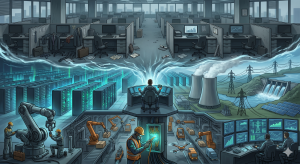
The End of the Office Economy
If all white-collar work were fully automated, the result would not just be a wave of layoffs. It would be the most dramatic economic reset in modern history.
Programming, legal analysis, financial planning, corporate management, accounting, marketing, administration, consulting, and much of strategy work all share one basic feature: they happen mostly through language, logic, planning, and screens. If artificial intelligence could perform those tasks at near-zero marginal cost, the office economy would lose its central role in supporting the middle class.
The change would be bigger than “people lose office jobs.” It would mean that income, status, and security are no longer reliably tied to intellectual labor.
For generations, the basic middle-class formula looked like this:
- get educated
- enter a professional field
- sell your knowledge
- earn a salary
- buy a home
- build stability
Full white-collar automation breaks that formula. It does not eliminate all human value, but it does eliminate the assumption that most people can earn a living by thinking, typing, analyzing, managing, or communicating inside a company.
The old economy rewarded:
- degrees
- credentials
- analysis
- management
- office productivity
- corporate hierarchy
- professional specialization
The automated economy would reward:
- ownership
- energy access
- physical execution
- maintenance skills
- human trust
- land
- infrastructure
- intellectual property
- control over AI systems
That is the real transformation. Intelligence becomes abundant. Ownership becomes everything.
1. The Scale of the Shock
This is not a small corner of the economy. Even before imagining total automation, major institutions already estimate that AI exposure reaches a huge share of the labor market.
The rough scale looks like this:
- about 40% of global employment is exposed to AI
- in advanced economies, about 60% of jobs may be affected
- around 300 million jobs globally are exposed to AI automation
- in the United States, AI could potentially automate tasks equal to 25% of all work hours
- generative AI could add $2.6 trillion to $4.4 trillion in annual economic value across analyzed use cases
Those numbers point to the central conflict of the AI economy. The issue is not whether value gets created. It almost certainly does. The issue is who receives it.
If AI systems produce trillions of dollars in value while requiring far fewer human workers, then the economy becomes richer while many workers become less necessary. That is a dangerous combination. It creates abundance at the top and anxiety everywhere else.
A fully automated white-collar economy would not be poor. It might be extraordinarily productive. But productivity and prosperity are not the same thing. Productivity measures how much value gets created. Prosperity depends on how that value is distributed.
2. When Intelligence Becomes Cheap, Physical Reality Gets Expensive
The first major industrial shift would be the collapse in the price of intelligence.
Today, companies pay huge sums for human cognition. They hire people to write code, review contracts, prepare reports, manage logistics, plan budgets, design campaigns, analyze markets, process paperwork, and supervise teams. In a fully automated white-collar economy, those functions could be performed by AI systems operating constantly and cheaply.
That changes what businesses struggle with.
The new bottlenecks would not be emails, slide decks, spreadsheets, or legal memos. They would be physical constraints:
- electricity
- data centers
- chips
- cooling systems
- land
- water
- fiber networks
- grid capacity
- construction labor
- maintenance technicians
- robotics hardware
- minerals and raw materials
- warehouses and transport routes
In other words, bits become cheap, but atoms stay expensive.
This is why physical infrastructure becomes more important, not less. AI does not float above the economy. It runs on machines, and those machines need power, buildings, cooling, land, permits, supply chains, and workers who can install and repair them.
Data centers alone show the direction of travel. Global data center electricity consumption is projected to reach around 945 TWh by 2030, roughly double is previous level. From now to 2030, data center electricity consumption is projected to grow by about 15% per year.
That means the future AI economy depends heavily on things that cannot be downloaded:
- power plants
- transmission lines
- substations
- electricians
- HVAC systems
- construction crews
- chip factories
- battery storage
- water systems
- industrial maintenance
The next great economic advantage may not belong to the city with the most consultants. It may belong to the region with cheap power, available land, strong fiber access, fast permitting, and a workforce that can build.
3. The Rise of the Physical Premium
If software, legal analysis, accounting, coding, management, and planning become cheap, then physical execution becomes more valuable by comparison.
This creates what could be called the physical premium.
The jobs that remain difficult to automate are not always glamorous, but they are grounded in messy reality. A plumber working inside an old building, an electrician tracing a strange wiring problem, a machinist repairing custom equipment, or a technician maintaining robotics infrastructure faces unpredictable conditions. Those jobs require dexterity, judgment, improvisation, and spatial understanding.
Robots are improving, but physical work in unstructured environments is hard. A screen-based task can often be copied, scaled, and automated. A physical task must be done somewhere, with real materials, under real constraints.
That gives certain workers new leverage (the same list as above, electricians, plumbers, etc.)
Some of these jobs already show the direction of demand. Construction and extraction occupations are projected to have about 649,300 openings per year in the United States. Installation, maintenance, and repair occupations are projected to have about 608,100 openings per year.
But there is a problem. Even if trades gain status and wages, they cannot absorb everyone displaced from the office economy.
The U.S. economy is projected to add only 5.2 million jobs from 2024 to 2034. That is not nearly enough to offset a hypothetical world where large portions of the professional class lose their economic role. The numbers do not balance.
That creates the central contradiction:
- AI could expose hundreds of millions of jobs globally.
- Trades and infrastructure work will grow, but not enough to absorb the entire former office class.
- Care work will grow, but much of it remains low-paid.
- The economy may need fewer workers overall, even while certain physical workers become more valuable.
So no, everyone would not simply “go work labor jobs.” Some people would. Many could not. Many would be pushed into a different kind of service economy.
4. The Human-Presence Economy
When intelligence is automated, human presence becomes a separate category of value.
There will still be demand for work where the human being is not just a tool for completing a task, but part of the product itself. People may accept an AI-generated tax form or software patch. They may be less willing to accept an AI as a parent’s caregiver, a therapist, a spiritual leader, a personal coach, a teacher for their child, or the host of an intimate luxury experience.
That does not mean AI will be absent from these fields. It will probably assist them heavily. But the human layer may remain valuable because people care about being seen by another person.
This creates a “human premium” sector:
- caregiving
- therapy
- teaching
- coaching
- elite hospitality
- live performance
- religious leadership
- community organizing
- philosophy
- local politics
- handmade goods
- boutique travel
- high-trust advising
- human-certified creative work
Caregiving is one of the clearest examples. Home health and personal care aides are projected to grow 17% from 2024 to 2034, with about 765,800 openings per year in the United States. But the median annual wage was only $34,900 in May 2024.
That tells us something important. Human-centered work may be socially necessary, but that does not automatically make it well-paid. A society can desperately need caregivers while still underpaying them. Automation may make that contradiction harder to ignore.
In a post-office economy, the question becomes whether emotionally valuable work gets treated as real economic value, or whether it remains low-status labor performed by people with few alternatives.
5. The Middle Class Gets Rebuilt, But Smaller
The traditional middle class would be hit hardest.
The modern middle class is built around white-collar employment. It includes managers, analysts, accountants, programmers, lawyers, consultants, marketers, administrators, designers, financial planners, HR workers, and corporate specialists. These are the people who turned education into salary, salary into homeownership, and homeownership into intergenerational stability.
Full white-collar automation would fracture that entire structure.
The new middle class would likely split into three groups.
The physical specialists
These are people who work at the boundary between AI and the material world. They install, repair, operate, or maintain the infrastructure that automation depends on.
They include:
- electricians
- automation mechanics
- robotics technicians
- industrial repair workers
- energy workers
- advanced manufacturing specialists
- construction experts
- medical equipment technicians
Their value comes from being hard to replace in real-world environments.
The human-authenticity class
These are people whose work is valuable because it is human. Their role is not just to produce an output, but to create trust, meaning, taste, care, or status.
They include:
- therapists
- teachers
- artists
- craftspeople
- chefs
- performers
- coaches
- boutique builders
- community leaders
- spiritual guides
- local organizers
In a world flooded with machine output, the phrase “made by a person” becomes a luxury label.
The local ownership class
These are people who may not own the big AI platforms, but who own small pieces of the physical or social economy.
They include:
- local business owners
- landlords
- franchise operators
- farm owners
- workshop owners
- small manufacturers
- local service providers
- regional logistics operators
They survive because they own something that still matters locally: land, equipment, reputation, customers, or physical access.
This new middle class may exist, but it would probably be narrower and less secure than the old one. The old corporate ladder allowed millions of people to rise through stable salaried work. The new economy may offer fewer ladders and more cliffs.
6. The Entry-Level Ladder Breaks First
One of the most serious effects of AI automation is that it may destroy the jobs people use to become experts.
Entry-level white-collar work often looks boring from the outside. Junior employees write first drafts, clean spreadsheets, review documents, summarize meetings, prepare research, test code, answer customer questions, and build reports. But that is how they learn.
If AI performs the junior work, the career ladder starts missing its bottom rungs.
This creates a strange problem:
- society may still need senior lawyers, but fewer junior lawyers get trained
- society may still need senior engineers, but fewer junior engineers get real practice
- society may still need financial experts, but fewer analysts learn by doing
- society may still need managers, but fewer people learn inside organizations
- society may still need doctors, architects, accountants, and researchers, but their training pipelines become thinner
The first jobs to disappear may be the jobs people used to learn from.
That is a deeper problem than unemployment. It is a knowledge-transfer crisis. A society cannot produce senior judgment if it removes too many of the apprentice roles where judgment develops.
7. College Loses Some of Its Economic Magic
Education would not become useless. But the economic meaning of education would change.
For decades, the college degree functioned as a ticket into the professional class. It did not guarantee wealth, but it usually improved the odds of stable employment, higher earnings, and social mobility.
In a fully automated white-collar economy, that promise weakens.
The crisis would not just be unemployment. It would be credential collapse:
- degrees lose pricing power
- apprenticeships gain status
- trade schools become more attractive
- elite universities survive as networking pipelines
- ordinary professional degrees become riskier investments
- students think harder about debt
- families stop assuming office work is the safest path
- education shifts from “job preparation” toward judgment, taste, ethics, and social capital
Elite education would probably remain powerful, but for different reasons. The top universities would still connect people to capital, founders, investors, institutions, and status networks. But the average degree aimed at average office employment would become less reliable.
The old formula was:
- degree
- office job
- salary
- mortgage
- stability
The new formula may become:
- ownership
- scarce skill
- physical capability
- trusted human relationship
- local network
- access to capital
That is a much harder path for the average person.
8. Trust Becomes an Industry
When intelligence becomes cheap, deception also becomes cheap.
AI can generate emails, contracts, reports, voices, images, videos, resumes, customer complaints, legal threats, fake employees, fake businesses, fake reviews, fake relationships, and fake expertise. If every institution is flooded with synthetic content, the scarce resource becomes trust.
This creates a major new industry around verification.
Likely growth areas include:
- identity verification
- cybersecurity
- fraud detection
- human auditing
- reputation systems
- verified communication
- courts and arbitration
- media provenance
- professional certification
- “human signed” work
- authentication of art, video, audio, and documents
The more automation spreads, the more valuable it becomes to prove that something is real, accountable, and attached to a person or institution that can be trusted.
That means some human jobs will survive not because humans are faster, but because they are accountable. A person can sign, testify, appear in court, build a reputation, lose a license, or be socially punished. A machine cannot carry responsibility in the same way.
9. Employees Become Training Data
One of the clearest real-world previews of this future came from Meta.
In 2026, Meta reportedly began rolling out tracking software on U.S.-based employee computers through an internal program called the Model Capability Initiative, or MCI. The system was designed to capture workplace computer behavior, including mouse movements, clicks, keystrokes, menu navigation, dropdown use, and occasional screen snapshots, so AI agents could learn how humans perform software-based work.
The official logic was straightforward: if AI agents are going to complete everyday computer tasks, they need examples of how people actually use computers.
But the deeper meaning is much more uncomfortable.
Some employees reportedly pushed back against the project and used the phrase “Employee Data Extraction Factory.” That phrase should not be treated as Meta’s official name for the program. It was reportedly a protest phrase from employees. But it captures one of the most important dynamics of white-collar automation: workers may not only be replaced by AI. They may first be used to train the AI that replaces them.
That changes the psychological contract of work.
In the old office economy, a worker gave a company labor in exchange for wages. In the AI office economy, a worker may give the company three things at once:
- their labor
- their behavioral data
- the training examples needed to automate their own role
This is more than workplace surveillance. It is a new form of extraction.
The company does not merely watch the employee to measure productivity. It watches the employee to convert their habits, judgment, clicks, pauses, shortcuts, corrections, and workflows into machine training data.
That creates a new workplace fear:
- every email becomes an example
- every spreadsheet correction becomes an example
- every mouse movement becomes an example
- every code change becomes an example
- every copied-and-pasted item becomes an example
- every meeting summary becomes an example
- every workflow becomes a template
- every expert intervention becomes training material
The employee becomes both the worker and the dataset.
This also explains why the politics of AI will not only be about jobs. It will be about data rights. Workers may begin demanding protections not only over wages, hours, and benefits, but over the use of their behavioral data.
The next generation of labor organizing may ask questions like:
- Can companies use employee activity to train automation systems?
- Do workers have a right to opt out?
- Should employees be paid when their behavior becomes training data?
- Can a company use worker-generated data to eliminate worker jobs?
- Should workplace data be treated as labor, property, or surveillance?
- Should employees have the right to delete, audit, or license their work data?
- Should unions negotiate over AI training rights?
The Meta example matters because it makes the abstract future visible. White-collar automation is not just something that happens from outside the office. It can be built from inside the office by capturing the behavior of the workers still doing the jobs.
That is the quietest and most disturbing version of the transition. The office does not disappear overnight. First, it is measured. Then it is modeled. Then it is automated.
10. The Lower Class Expands Without Policy Intervention
If society keeps survival tied to employment, full white-collar automation would likely expand the lower class dramatically.
This group would include:
- former administrative workers
- displaced entry-level professionals
- customer support workers
- junior analysts
- paralegals
- clerks
- bookkeepers
- back-office employees
- low-wage service workers
- gig workers
- people unable to retrain fast enough
- people whose credentials no longer command wages
They would compete for the remaining jobs where humans are still cheaper, more trusted, or more practical than machines.
That includes:
- basic caregiving
- cleaning
- delivery
- local maintenance
- food service
- warehouse work
- elder care
- child care
- security
- informal gig work
- low-level hospitality
The danger is that many of these jobs are necessary but not well-paid. If millions of former office workers enter the same labor pool, wages could come under pressure unless labor markets are protected by unions, shortages, regulation, or public policy.
This would create enormous political instability. People are unlikely to accept a society where automated systems generate extraordinary wealth while millions struggle to afford housing, healthcare, food, and family life.
The issue would not only be economic. It would be moral.
What does society owe people when their labor is no longer needed?
Who deserves income when machines do most of the productive work?
Can a person have dignity without a job?
Should ownership determine who lives comfortably and who barely survives?
Those questions would move from philosophy seminars to election campaigns.
11. The Upper Class Becomes the Automation Ownership Class
At the top, the class structure becomes brutally simple.
The winners are the people and institutions that own the systems.
The new upper class would include owners of:
- AI models
- cloud platforms
- data centers
- chip supply chains
- robotics companies
- energy infrastructure
- land
- mineral rights
- logistics networks
- proprietary data
- patents
- media platforms
- financial platforms
- defense technology
- automation-heavy firms
They would not need large white-collar payrolls. That is what makes this scenario so unequal.
A company that once needed thousands of programmers, lawyers, accountants, analysts, HR workers, and managers might operate with a much smaller human staff. The work would still happen, but not through wages. It would happen through owned systems.
That means wealth flows away from labor and toward capital.
This would not begin from a neutral starting point. In the third quarter of 2025, the top 1% of U.S. households held 31.7% of net worth. The next 9% held 36.4%. Together, the top 10% held about 68.1% of household net worth. The bottom 50% held only 2.5%.
Automation would amplify that existing imbalance unless something redirects the gains.
The old divide was often described as white-collar versus blue-collar. The new divide would be different:
- people who own automation
- people who maintain automation
- people who serve automation owners
- people displaced by automation
That is a much harsher class structure.
12. Geography Changes
The office economy made certain cities extremely powerful. New York, San Francisco, London, Washington, Seattle, Boston, and similar hubs benefited from finance, technology, law, consulting, media, government, and corporate headquarters.
If white-collar work is automated, some of that advantage weakens.
A city full of analysts, lawyers, consultants, administrators, and managers becomes less economically secure if those functions can be performed by AI. The next boomtown may not be the place with the most office towers. It may be the place with the right physical inputs.
Future growth could shift toward regions with:
- cheap electricity
- open land
- grid capacity
- cooling advantages
- water access
- fiber connectivity
- fast permitting
- construction labor
- proximity to energy production
- favorable tax treatment
- industrial infrastructure
That could revive some regions and weaken others. Expensive knowledge-work cities may still matter as cultural, financial, and ownership hubs. But the physical base of the AI economy could make energy regions, industrial corridors, and data center zones far more important.
The geography of intelligence may become less important than the geography of power.
13. The Political Fight Moves From Jobs to Ownership
In the old economy, politics focused heavily on jobs.
Politicians promised to create jobs, protect jobs, bring jobs back, improve wages, support unions, attract employers, and grow industries. That made sense in a world where employment was the main way people accessed income.
But in a fully automated white-collar economy, the bigger question is not “How do we create enough jobs?”
The bigger question is:
Who owns the systems that replaced the jobs?
That opens the door to much larger debates:
- universal basic income
- public AI funds
- sovereign wealth dividends
- robot taxes
- data dividends
- national compute reserves
- public ownership stakes in AI infrastructure
- cooperative ownership of automation
- municipal ownership of energy assets
- stronger taxation of automated profits
- expanded public healthcare, housing, and education
- shorter workweeks
- guaranteed public employment
- social wealth funds
One existing miniature model is Alaska’s Permanent Fund Dividend. It does not solve automation, and $1,000 per eligible resident is not enough to replace wages. But it shows the basic idea: a shared asset can produce a public dividend.
A post-AI society may need something similar at a much larger scale. If AI, compute, data, robotics, and energy infrastructure create vast wealth, governments may need to treat part of that wealth as a shared social inheritance rather than a purely private windfall.
Without that kind of mechanism, the ownership class captures the gains while everyone else competes for whatever labor remains.
14. The Economy Stops Being About Work
The deepest change would be philosophical.
Modern society treats work as the center of adult life. Work provides income, structure, identity, status, discipline, routine, and social respect. People do not just work to live. They are taught that work proves their worth.
Full white-collar automation breaks that belief system.
If machines can perform most cognitive labor, then human value cannot be measured mainly by productivity. A person’s right to live with dignity cannot depend entirely on whether the labor market currently needs their skills.
That would require a new social contract.
The measure of a successful economy would have to shift from:
- employment rates
- GDP growth
- productivity
- corporate profits
- wage labor
- credential attainment
toward:
- distribution
- stability
- health
- housing security
- access to care
- civic participation
- human development
- leisure
- community strength
- environmental sustainability
- trust in institutions
The great question of the automated age will not be whether society can produce enough. It almost certainly can.
The question is whether society can distribute enough.
If it cannot, automation produces a strange dystopia: a world of technical abundance and human insecurity. The machines work. The systems optimize. The profits rise. But millions of people lose the economic role that once justified their access to a decent life.
If it can, automation could become the beginning of a different civilization, one where survival is no longer chained to office labor, education is not reduced to job training, and human beings are free to spend more of their lives on care, creativity, community, philosophy, family, and craft.
The end of white-collar work would not have to mean the end of human purpose.
But it would mean the end of the economy as we know it.
References
International Monetary Fund, “almost 40 percent of global employment is exposed to AI.”
International Monetary Fund, “about 60 percent of jobs may be impacted by AI.”
Goldman Sachs, “around 300 million jobs are exposed to AI automation.”
Goldman Sachs, “automate tasks that account for 25% of all work hours.”
McKinsey, “$2.6 trillion to $4.4 trillion annually.”
International Energy Agency, “projected to double to reach around 945 TWh by 2030.”
International Energy Agency, “data centre electricity consumption grows by around 15% per year.”
U.S. Bureau of Labor Statistics, “grow by 5.2 million from 2024 to 2034.”
U.S. Bureau of Labor Statistics, “About 649,300 openings are projected each year.”
U.S. Bureau of Labor Statistics, “About 608,100 openings are projected each year.”
U.S. Bureau of Labor Statistics, “projected to grow 17 percent from 2024 to 2034.”
U.S. Bureau of Labor Statistics, “About 765,800 openings.”
U.S. Bureau of Labor Statistics, “$34,900 in May 2024.”
FRED, “Q3 2025: 31.70000.”
FRED, “Q3 2025: 36.4.”
FRED, “Q3 2025: 2.5.”
Alaska Department of Revenue, “The 2025 Permanent Fund Dividend amount is $1,000.”
Reuters, “capture mouse movements, clicks and keystrokes.”
Reuters, “The tool, called Model Capability Initiative (MCI).”
Reuters, “more than 200 apps and websites.”
Reuters, “Employee Data Extraction Factory.”