
Optimize, Rebuild, Replace, or Leave It Alone? What to Do With an Existing WordPress Site
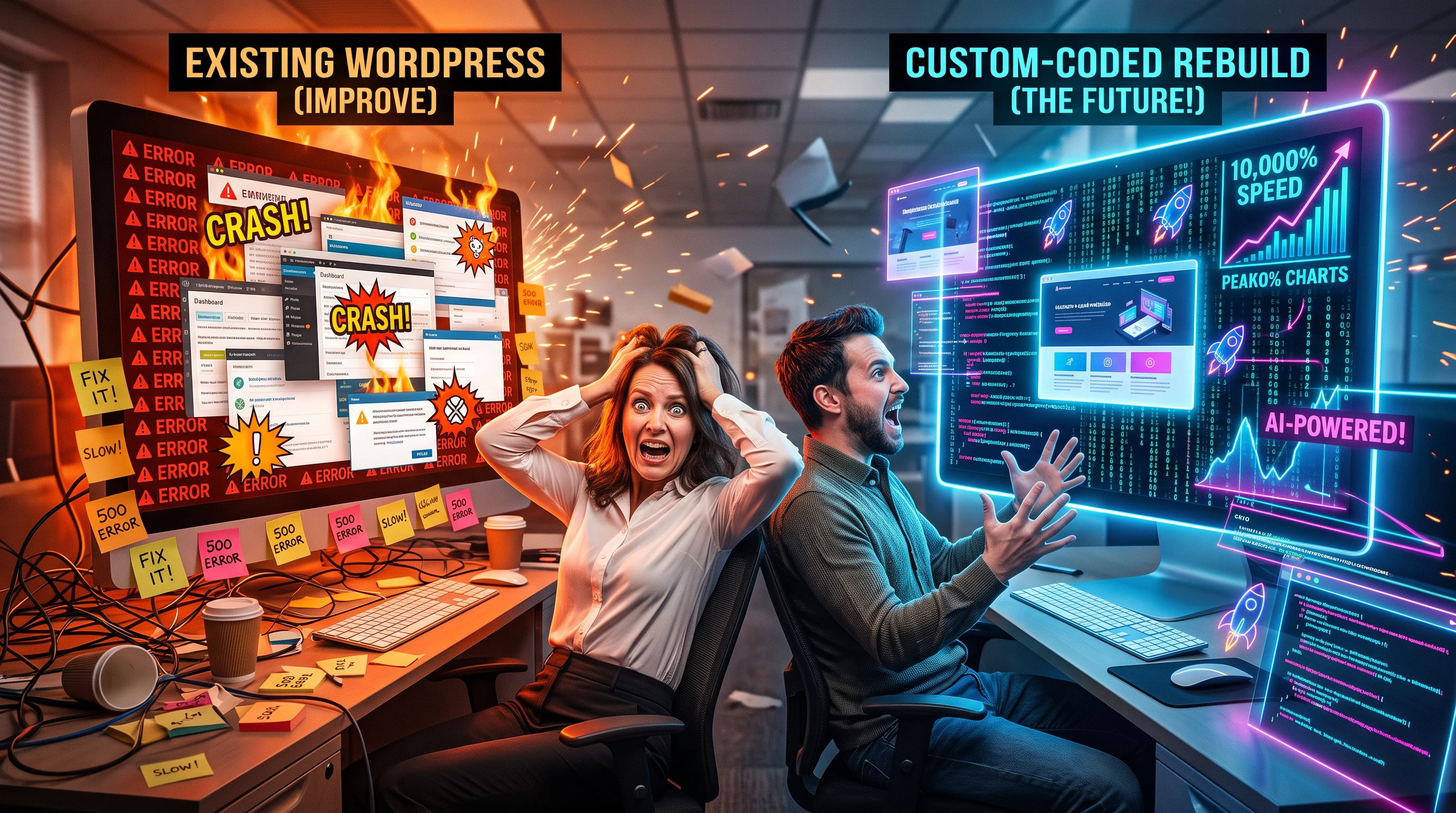
A slow or awkward WordPress site can make a full replacement sound like the obvious answer. A development team may promise cleaner code, a modern framework, better performance, and a faster path to new features. Those advantages can be real. They are not automatic, and they do not mean WordPress is the wrong platform for every business.
The opposite mistake is just as common. A company keeps adding plugins, page-builder sections, caching layers, and emergency fixes because replacing the site sounds disruptive. The site technically stays online, but every change becomes slower, riskier, and more expensive.
There are really four choices: leave the site alone, optimize it, rebuild it on WordPress, or replace it with a different platform or a custom-coded website. The right choice is the smallest one that solves the actual business problem without creating a larger one.
That distinction matters because Honor Tech can support either direction. We have WordPress expertise for sites that should remain on WordPress, and experienced software engineers who can build a fast, modern code-based site when replacement is justified. The goal is not to make one platform win. It is to make the website fit the business.
The short answer
Leave the site alone when it is secure, supported, easy enough to manage, and helping customers take the actions that matter. A newer technology stack is not a business outcome by itself.
Optimize the existing WordPress site when the underlying structure is healthy and the problems are specific: oversized images, slow hosting, too many third-party scripts, poor caching, an untidy plugin list, weak page hierarchy, accessibility issues, or confusing calls to action.
Rebuild on WordPress when the business still benefits from WordPress editing and publishing, but the current theme, page builder, templates, and accumulated customizations are blocking meaningful improvement.
Replace WordPress when the platform and its operating model no longer fit: the experience needs application-like behavior, integrations dominate the project, the plugin dependency chain is unmanageable, the site needs a highly controlled delivery architecture, or the long-term value of a purpose-built codebase justifies migration.
| Option | What stays | Best fit | Main tradeoff |
|---|---|---|---|
| Leave it alone | The site, theme, plugins, hosting, and editing workflow | The site is secure, supported, useful, and meeting its goals | You accept the current design and technical limits |
| Optimize | WordPress and most of the current site | The foundation is sound but speed, usability, content, or maintenance needs focused improvement | Optimization cannot remove a structural limitation |
| Rebuild | WordPress and its editorial benefits | The business still needs WordPress, but the theme, templates, or plugin structure have become the problem | A rebuild costs more and still carries launch risk |
| Replace | The content and business purpose, but not necessarily the platform | WordPress no longer fits the required performance, design, integration, security, or operating model | Migration and future code ownership must be managed deliberately |
First, define what is actually wrong
“The website feels old” is a useful signal, but it is not yet a scope. Before choosing a technical direction, separate the problems into categories.
Several of these problems may be present at once, but they do not all point to the same solution. A weak headline does not require a new framework. A deeply coupled page builder cannot always be repaired with another performance plugin. A good assessment identifies which layer is failing before anyone proposes replacing the whole stack.
Option one: leave the WordPress site alone
Doing nothing can be the responsible choice.
If the site is maintained, backed up, reasonably fast for its real audience, accessible enough for its use, easy for staff to edit, and producing the results the business needs, a rebuild may only exchange known limitations for new cost and risk.
This is especially true when the pressure to change comes from technology fashion rather than user evidence. A competitor launching a new design, a developer preferring a new framework, or a new AI website tool appearing in the market does not make an existing site obsolete.
Leaving the site alone should still include normal ownership. WordPress core, the theme, and active plugins need an update process. Backups should be recoverable rather than merely scheduled. Unused plugins and accounts should not accumulate indefinitely. Analytics and forms should be checked. The domain and hosting accounts should remain under known control.
Signs that leaving it alone is reasonable include:
The main risk is complacency. “Leave it alone” should mean the site does not need a project right now, not that nobody is responsible for it.
Option two: optimize the existing WordPress site
Optimization keeps the platform and improves the areas that are underperforming. It is usually the best first investment when the problems can be isolated and the underlying site remains maintainable.
A real optimization effort starts with measurement rather than installing a random collection of speed plugins. Field performance, lab tests, hosting behavior, page weight, database health, third-party scripts, theme behavior, and high-value user journeys can reveal very different causes.
Common optimization work includes:
Performance should be judged with more than one score. Loading speed, interaction responsiveness, and layout stability all matter, but so do conversions, accessibility, content clarity, and reliability. A perfect laboratory score is not useful if the page no longer communicates the offer or the optimization removes tools the business genuinely needs.
Advantages of optimization
Limitations of optimization
Optimization is not a consolation prize. When it solves the problem, it is better engineering than replacing a working system.
Option three: rebuild the site and keep WordPress
A WordPress rebuild keeps the content-management platform but replaces much of the implementation around it. That might mean a new custom theme, cleaner templates, a smaller and more intentional plugin set, a redesigned content model, reusable blocks, and a more disciplined deployment process.
This path makes sense when the business still values WordPress for frequent publishing, nontechnical editing, user roles, media management, mature integrations, or an established e-commerce and editorial workflow. The platform remains useful; the current construction does not.
A rebuild is different from painting over the existing theme. It should reconsider how pages are assembled, which plugins are essential, which features belong in custom theme or plugin code, and how content can remain portable. It is also an opportunity to remove abandoned content, clarify templates, and give editors guardrails that prevent every page from becoming a unique design experiment.
Advantages of rebuilding on WordPress
Limitations of rebuilding on WordPress
The best WordPress rebuilds are intentional about what WordPress should own. Content editing, media, users, and publishing may belong there. Highly specialized application behavior may belong in a separate service or application connected through a supported interface.
Option four: replace WordPress with a modern code-based website
Replacement moves the public site to a different architecture. That could be a statically generated site, a server-rendered application, a custom content system, a hosted platform, or a hybrid that combines a separate editing system with a purpose-built front end.
This path is attractive when the website needs extremely controlled performance, a distinctive experience, deep integrations, application-like behavior, a more rigorous deployment model, or a reduction in the runtime and plugin surface exposed to the public internet.
Modern development tools, reusable components, automated testing, cloud platforms, and AI-assisted engineering can make this work faster than it was a few years ago. AI can help experienced developers explore an unfamiliar codebase, scaffold components, generate test cases, migrate structured content, and accelerate repetitive implementation. It does not remove the need to make sound architecture, accessibility, security, content, or migration decisions.
Honor Tech uses modern tools to move quickly, but speed is valuable only when the result remains understandable and supportable. A site assembled rapidly without ownership, tests, deployment knowledge, or a content plan can become tomorrow's legacy system regardless of how modern its framework looked at launch.
Advantages of replacement
Limitations of replacement
A coded site can be exceptionally fast. WordPress can also be fast. Either can be slow when burdened by poor implementation, oversized media, third-party scripts, weak hosting, or careless design. Technology creates possibilities; engineering and ongoing ownership determine whether those possibilities become results.
What about headless WordPress?
Headless WordPress keeps WordPress as the content system while a separate code-based front end displays the site. It can preserve editorial familiarity while giving developers more control over presentation and delivery.
It can also create two systems to operate instead of one. The preview experience, forms, search, redirects, menus, plugins, authentication, caching, and publishing workflow may require new connections or replacements. Some plugins only affect traditional WordPress rendering and do not automatically carry into a headless front end.
Headless WordPress is useful when the separation has a clear purpose: content must feed several channels, the front end needs capabilities that are difficult to deliver in the current theme, or a product team already has the engineering practices to own both sides. It should not be selected merely because it sounds like a compromise between WordPress and modern code.
WordPress versus custom code for SEO
Neither platform receives an automatic ranking advantage.
Search performance depends on whether search engines can discover, render, understand, and trust useful pages that satisfy real searches. WordPress offers mature tools for titles, descriptions, canonicals, sitemaps, redirects, structured data, editing, and internal linking. A code-based site can implement those capabilities with more direct control and less runtime overhead. Either approach can get them wrong.
The SEO case for change should be specific. Examples include templates that produce duplicate or inaccessible content, performance problems that cannot be corrected economically, a page builder that prevents clean content structure, or technical limitations that block the experience users need. “Custom code is better for SEO” is not a migration plan.
If WordPress already ranks and the site is being replaced, the existing search footprint is an asset that must be carried forward. The project should inventory current URLs, traffic, backlinks, titles, descriptions, headings, structured data, internal links, images, downloads, and high-performing content before launch decisions make any of them difficult to recover.
How to replace WordPress without throwing away SEO value
The safest migration keeps valuable URLs unchanged when practical. When a URL must change, map it to the closest relevant destination and use a direct permanent server-side redirect. Sending every retired page to the home page is not a substitute for a real redirect plan.
The launch checklist should include:
It is often safer to avoid changing the domain, platform, design, URL structure, and all page copy at the same moment. When practical, change fewer variables at once so problems are easier to isolate. A migration may still produce temporary ranking movement while search systems recrawl and process the new site. That possibility belongs in the launch plan, not in a promise that rankings cannot change.
Compare total cost, not just the build quote
The least expensive first step and the least expensive long-term choice are not always the same.
For WordPress, include hosting, premium themes and plugins, maintenance, updates, backups, security monitoring, incident response, performance work, accessibility remediation, content administration, and the cost of debugging conflicts.
For a rebuilt WordPress site, add discovery, design, content work, development, plugin replacement, migration, testing, launch, training, and ongoing theme or plugin support.
For a code-based replacement, include design, content modeling, front-end and back-end development, content editing tools, hosting, deployment, monitoring, forms, search, integrations, testing, accessibility, security, and future engineering support.
Also include the cost of doing nothing. Slow pages, broken forms, confusing navigation, inconsistent branding, security incidents, manual publishing work, and missed opportunities all have value even when they do not appear on a software invoice.
The comparison should cover several years and include the people who will operate the site. A cheaper platform that requires a developer for every routine edit may be expensive for a marketing team. A familiar CMS that consumes technical support every month may be expensive in a different way.
A practical decision process
Start with evidence from the existing site. Review analytics and search performance, test important journeys on real devices, inspect the WordPress installation, identify plugin and theme dependencies, review hosting and backups, and talk with the people who publish content.
Then write down the non-negotiable requirements:
Estimate all four paths against the same requirements. Do not compare a bare optimization quote with a replacement proposal that includes a complete redesign, content rewrite, analytics repair, and years of accumulated cleanup. Make the scopes comparable.
If the evidence is incomplete, begin with a bounded assessment or a small technical proof. Test whether the biggest performance problem can be fixed. Prototype the hardest interaction. Export representative content. Build the redirect inventory. Confirm that the future editing workflow works for the people who will use it.
Use AI to accelerate the work, not to skip the thinking
AI-assisted development changes the economics of website work. Experienced teams can produce and evaluate implementation options faster, automate repetitive transformations, test more cases, and move from design intent to working components with less manual effort.
It also makes it easier to generate a large amount of code before the underlying decision is clear. A fast rebuild of the wrong architecture is still waste. A migration script that moves text but loses metadata, relationships, downloads, or redirects is not complete. Generated components still need accessibility, responsive behavior, security, performance, and maintainability review.
The useful question is not whether AI can rebuild the site. It probably can help. The question is whether rebuilding is the right move and whether the team using AI has the experience to recognize what must be preserved, tested, and operated afterward.
Choose the smallest responsible change
WordPress is not automatically outdated, and custom code is not automatically overengineering. Both can be excellent choices. Both can also become expensive when they are selected for the wrong reasons or maintained without ownership.
Leave the site alone when it is doing its job. Optimize it when focused improvements can solve the problem. Rebuild on WordPress when the platform still fits but the implementation does not. Replace it when the operating model, experience, integrations, or technical constraints justify owning a different foundation.
Honor Tech can help improve an existing WordPress site, rebuild it cleanly on WordPress, or plan and deliver a modern code-based replacement. We can also tell you when the evidence does not justify a large project. If you want a technical and business review of the current site, contact Honor Tech with the URL, the problems you are seeing, and the outcome you want the website to produce.